
Choosing a mobile app development company isn’t simple, especially when you’re running a startup. Plenty of agencies promise the world — fast timelines, high quality, the whole package. The tough part is figuring out who really delivers.
That’s why this piece gives you a straightforward way to evaluate partners. First, we break down eight key things to look for: industry knowledge, technical strength, QA processes, and more. Then you’ll find profiles of five solid companies, including their main services, focus areas, and what they’ve actually achieved for clients.
A Practical Guide to Picking a Mobile Development Partner
Finding a vendor is one thing. Finding the right long-term partner? That takes work. Use these eight criteria to evaluate your options.
1. Industry & Domain Expertise
Look for experience in your sector. FinTech, Healthcare, Logistics — whatever. Ask for case studies or references that match your needs. Compliance, legacy systems, user scale.
2. Technical Depth Across the Stack
A great mobile partner should offer more than front‑end coding. Verify their capabilities in:
- Backend development and cloud architecture (AWS, Azure, GCP);
- API design and systems integration;
- Data security and regulatory compliance;
- AI/analytics integration if needed.
3. Engagement Model Flexibility
Determine whether they offer:
- Dedicated teams / staff augmentation;
- Fixed-price or sprint‑based billing;
- Discovery‑only engagements.
The right model aligns with your budget, timeline, and internal team structure.
4. Design Maturity
Look at their portfolio. Is the UI polished and usable? Ask about their design process. Do they do user research and testing before coding?
5. QA & Testing
You should ask about test automation, device labs, security testing, and certifications including ISTQB or ISO. Finding issues early saves you money later, and that is a simple fact of software development.
6. Post-Launch Support
Get clear answers on maintenance SLAs and response times. How do they handle OS updates or new features? Avoid partners who disappear after launch.
7. Transparency
Look for regular demos and sprint reviews. Do you get access to their project tools? A good partner gives clear reports on progress, budget, and risks.
8. Client Proof Points
Don’t trust their website alone. Check Clutch, Gartner, or DesignRush ratings. Ask for client references. Look at case study metrics like time-to-market and ROI.
Use these criteria to shortlist two or three firms. Then run discovery calls or paid pilots before you commit.
Leading Mobile App Development Companies
We looked at three things when picking these five companies. Their track record. Their reputation in the industry. And their technical skills. Every profile includes a company overview, core mobile services, and key strengths. Use these to compare your options and build a shortlist.
Geniusee
Geniusee is a global mobile development company started in 2017 and has built a strong reputation. Today, they have over 300 people and have delivered more than 180 projects in areas like fintech, edtech, retail, manufacturing, and real estate.
Geniusee partners with a wide range of clients, from Y Combinator backed startups to large corporations. The company also holds several key certifications, such as AWS Advanced Tier Service Partner, ISTQB Platinum Partner, ISO 9001, and ISO 27001.
Core Services
Geniusee offers a range of mobile development services:
- Native iOS App Development – Tailored iOS apps with Swift and Objective-C that respect Apple’s Human Interface Guidelines.
- Native Android Development – Well-built Android applications using Kotlin and Java for excellent UX and security.
- Hybrid Cross-Platform Development – React Native projects that reduce costs and speed up time to market.
- AI-Driven Personalization – Adding smart AI features that offer personalized recommendations and adaptive interfaces.
- 5G Connectivity & IoT – Solutions for real-time IoT data in healthcare, logistics, and smart city applications.
- Legacy Mobile Upgrade – Modernizing old apps by migrating to newer frameworks and often adding AI capabilities.
Simform
Simform helps organizations build mobile apps that are actually innovative and easy to use. They bring in modern technologies like AI, machine learning, and AR/VR to make that happen.
Their team is made up of expert software engineers and developers. These guys craft scalable, reliable mobile solutions across the board. That includes tech stack consultations, application development, testing, deployments, and after-sales support. They also modernize legacy applications, which is something a lot of providers do not really focus on.
Core Services
Simform provides the following mobile development services:
- Native Apps – iOS and Android. Secure, high-performance code.
- Cross-Platform – React Native, Flutter, or Xamarin. One codebase.
- UI/UX Design – Responsive designs built for conversions.
- Enterprise Apps – CMS platforms and management dashboards.
- IoT Apps – Connects via Wi-Fi, Bluetooth, and NFC.
- API Integration – Links to existing business services.
- Mobile Backend – Scalable and secure architecture.
- QA & Support – Dedicated testing and fast error resolution.
Appinventiv
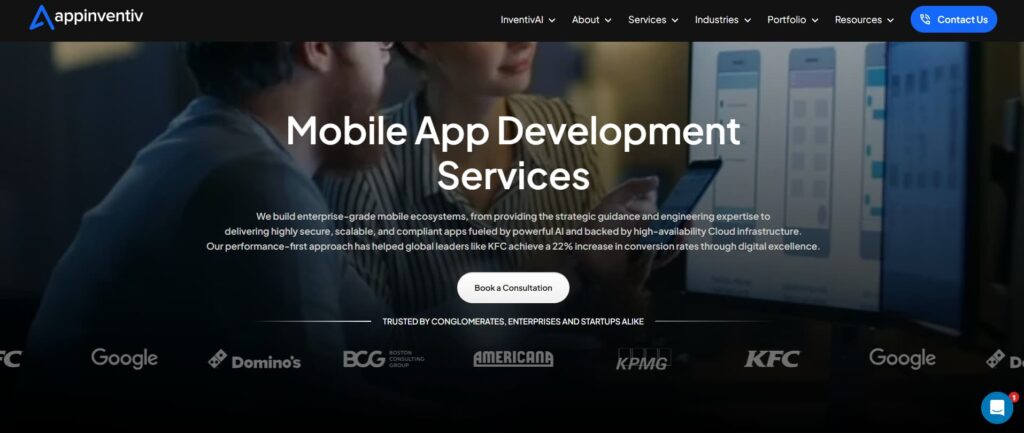
Appinventiv got started back in 2015. Since then they’ve been building mobile apps for everyone from early-stage startups to big companies. You’ll find them working a lot in healthcare, fintech, retail, and logistics.
They handle the whole process — strategy and design at the start, then the actual engineering, testing, and whatever support is needed down the line. The part they really nail is turning out scalable apps that plug into cloud services and other systems without much hassle.
Core Services
Here’s what they offer:
- Native App Development – Proper high-performance apps for iOS and Android that feel right at home on the device.
- Cross-Platform Development – Flutter and React Native work that gets you onto both platforms quicker.
- UI/UX Design – Clean interfaces that just make sense and stay consistent no matter the screen.
- Enterprise Applications – Dashboards, team tools, and other internal systems built for real work.
- Testing & Quality Assurance – The usual checks plus performance and security testing that actually matters.
- Maintenance & Support – Updates and help after the app goes live.
Infinum
For over twenty years, Infinum has focused on creating mobile and web applications. They’ve delivered more than 1,000 projects for big names including Philips, KPMG, and Mara.
What stands out is their mix of experienced developers and smart AI tools that actually make development smoother and more reliable. They stick to agile methods, which means they can usually get a working MVP out relatively quickly — often within a few months.
Core Services
Infinum offers these mobile development services:
- Android Development – Scalable apps for smartphones, tablets, and wearables with modern Kotlin and Java tools.
- iOS Development – User-friendly iOS apps using Swift and SwiftUI.
- Cross-Platform Development – React Native, Flutter, and Kotlin Multiplatform solutions that cut development time and cost.
- Mobile App Optimization – Improving and refactoring older apps.
- Maintenance & Support – Post-launch care and updates.
- QA Consulting – Help with better testing processes and results.
Fingent
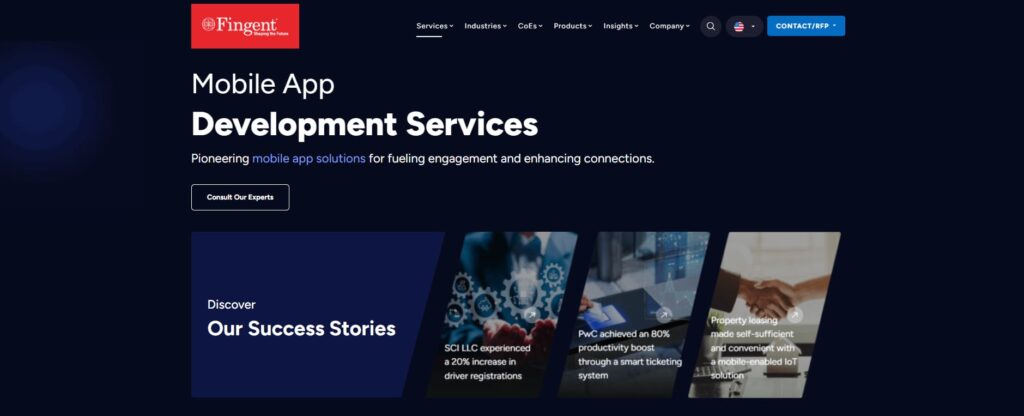
Fingent has been around since 2003. That means they have over twenty years of experience now, mostly focused on delivering custom mobile solutions for enterprises.
Their clients come from healthcare, finance, retail, logistics, and education. Pretty standard mix for a company at their level. What they actually build are tailored apps that help businesses connect with customers—and with their own workforce too.
Think secure, scalable mobile platforms. And they manage the whole development lifecycle from start to finish, including planning, building, and ongoing maintenance.
Core Services
Here’s what they offer:
- iOS development – Custom iPhone and iPad apps. Good performance and device integration.
- Android development – Feature-rich apps that handle large user bases.
- Hybrid and cross-platform – React Native, Ionic, Xamarin. One app, multiple platforms. Less time, less cost.
- Enterprise mobile apps – Connect employees to internal platforms. Boosts productivity and data access.
- Business integration – Connects mobile apps to existing enterprise software and APIs. Smooth data flow.
- Testing and deployment – End-to-end testing. Deployment to app stores or internal systems. Plus maintenance after launch so things keep running.
Conclusion
Finding the right mobile development partner takes more than just browsing portfolios and comparing hourly rates. A lot of people stop there, but those two things alone will not get you very far.
The eight criteria we just walked through give you a structured way to separate reliable firms from the rest. That is what makes the process easier.
The five companies profiled here all have solid industry experience, client references, and strong technical skills. They are worth a closer look if your needs match what they offer.
Now here is a practical next step. Shortlist two or three companies that fit your needs. Ask them for relevant client references. And seriously consider running a small paid pilot or a discovery phase before you sign any long-term contract.
Do that, and you will likely get faster launches, better cost control, and an app that is easier to maintain down the road.